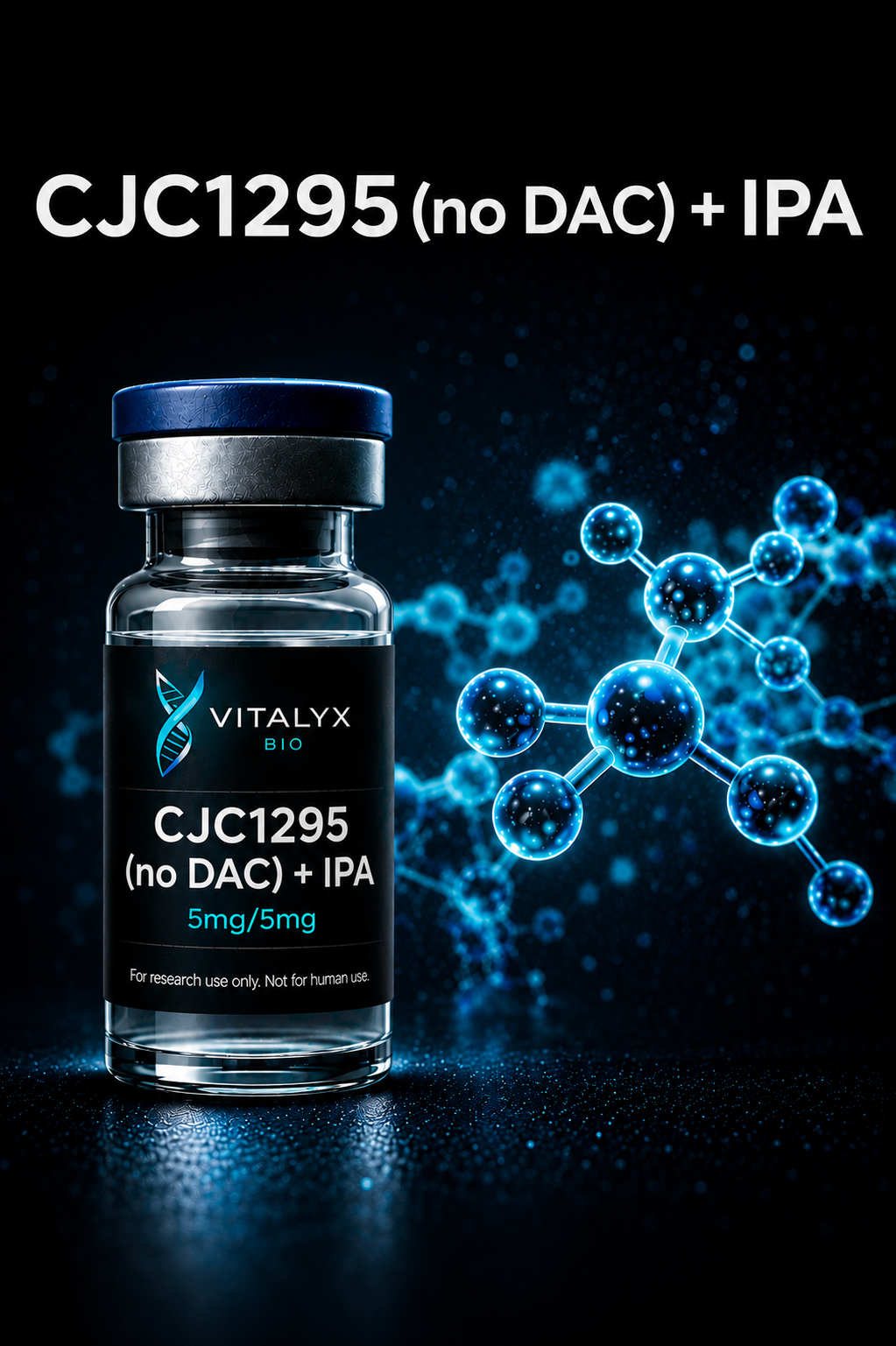
CJC-1295 (no DAC) + Ipamorelin — Growth-Hormone-Axis Research Blend
A two-peptide research blend pairing CJC-1295 without DAC (a GHRH analog) with Ipamorelin (a selective growth-hormone secretagogue). Each Vitalyx Bio vial contains 5 mg of each peptide as a lyophilized powder, supplied strictly for in-vitro and laboratory research.
Mechanism: Two Pathways, One Pulse
Combined-pathway protocols are studied for their effect on the amplitude of growth-hormone (GH) pulses, since each peptide in this blend acts on a different point of the same signaling loop:
- CJC-1295 (no DAC) — functions as a GHRH-receptor agonist, binding pituitary GHRH receptors to drive GH synthesis and release. The “no DAC” (Drug Affinity Complex) form carries a shorter half-life than DAC-modified analogs, which researchers select specifically because it more closely tracks the body’s own pulsatile GH release pattern rather than producing a sustained elevation.
- Ipamorelin — a selective ghrelin receptor (GHS-R1a) agonist. Rather than acting through the GHRH pathway, it is studied for suppressing somatostatin (the body’s natural brake on GH release) while directly prompting the pituitary to release stored GH — a second, independent lever on the same axis.
Key Research Focus Areas
- IGF-1 & Cellular Signaling — downstream IGF-1 upregulation and its studied role in tissue-repair signaling and protein-synthesis pathways.
- Metabolic Pathway Research — investigated for effects on basal metabolic markers, including adipose tissue oxidation and nitrogen balance.
- Receptor Selectivity — Ipamorelin’s comparatively narrow receptor profile is of particular research interest, with published data suggesting minimal cross-reactivity with cortisol, prolactin, or ACTH pathways relative to earlier-generation secretagogues.
- Circadian & Recovery Signaling — pulsatile GH release patterns are studied for their relationship to sleep-cycle architecture and recovery-phase signaling.
Why a Pre-Made Blend
One reconstituted vial, one matched pair — CJC-1295 (no DAC) and Ipamorelin are frequently studied together precisely because their mechanisms are complementary rather than redundant, and a pre-combined vial removes a manual-mixing step for protocols studying the pair.
Reconstitution & Storage
Store the sealed, lyophilized vial cool, dry, and protected from light. Reconstitute with bacteriostatic water, added slowly down the vial wall. Once reconstituted, store refrigerated at 2–8°C, minimize light exposure, avoid repeated freeze–thaw cycles, and avoid vigorous agitation of the vial, which can compromise peptide structural integrity. Defer to your laboratory’s standard handling protocols for aseptic technique and disposal.
Referenced Research
- Bowers, C.Y. (1990). Growth hormone (GH)-releasing peptide stimulates GH release in normal men and acts synergistically with GH-releasing hormone. The Journal of Clinical Endocrinology & Metabolism, 70(4), 975–982.
- Raun, K., Hansen, B.S., Johansen, N.L., Thøgersen, H., Madsen, K., Ankersen, M., & Andersen, P.H. (1998). Ipamorelin, the first selective growth hormone secretagogue. European Journal of Endocrinology, 139(5), 552–561.
- Teichman, S.L., Neale, A., Lawrence, B., Gagnon, C., Castaigne, J.-P., & Frohman, L.A. (2006). Prolonged stimulation of growth hormone (GH) and insulin-like growth factor I secretion by CJC-1295, a long-acting analog of GH-releasing hormone, in healthy adults. The Journal of Clinical Endocrinology & Metabolism, 91(3), 799–805.
This product is sold strictly for laboratory research use only. Not for human use, consumption, or therapeutic application.